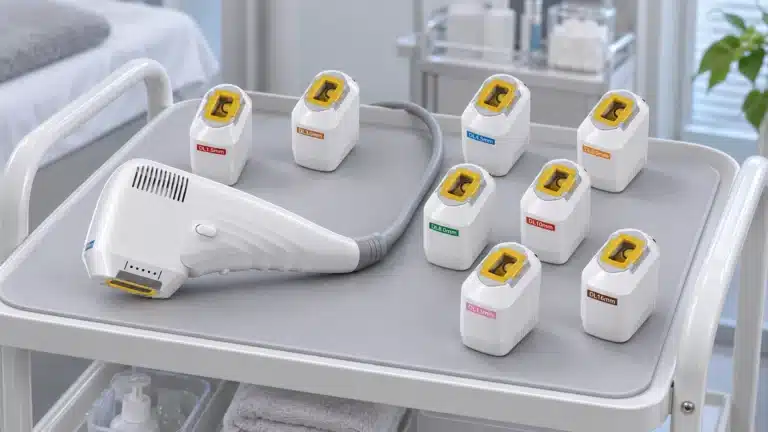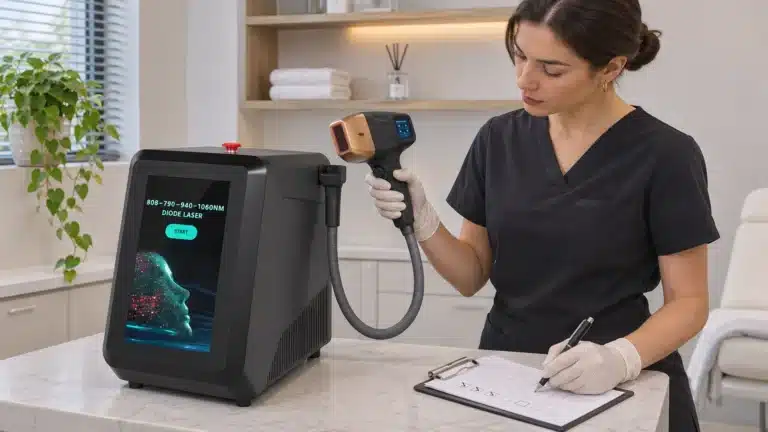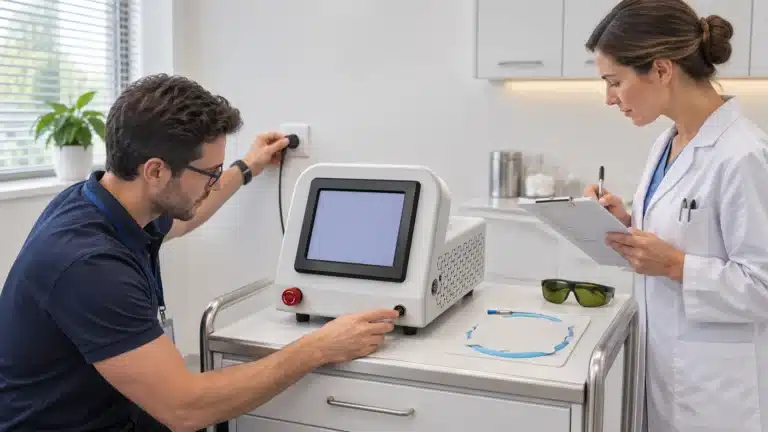
An effective aesthetic laser maintenance checklist separates operator care from work for a qualified service engineer. Staff can inspect external components, clean approved surfaces, review fault logs, check visible cooling indicators, and document changes. They should not open housings, adjust internal optics, bypass interlocks, or perform calibration unless authorized.
The exact model manual must set the interval. Daily, weekly, monthly, and annual categories organize work but do not override manufacturer, electrical-safety, or infection-control requirements.
Start with an asset register and the correct manual
Create one record for every machine before building a maintenance schedule. Include the manufacturer, model, serial number, software version, installation date, treatment room, handpieces, fibers or tips, cooling type, warranty terms, service contact, and the location of the current manual. If the clinic cannot identify the device and its accessories precisely, it cannot assign reliable maintenance tasks.
Use model-specific instructions. A water-cooled diode hair removal platform, a fiber-delivered 980 nm and 1470 nm system, and a fractional CO2 laser do not share the same internal architecture or operator-maintenance boundaries. The Arfurla product catalog shows why one generic checklist cannot cover every platform without qualification.
After installation, record normal startup time, cooling indicators, expected sounds, handpiece recognition, and self-test results. Staff can then identify changes without guessing.
Daily checks before the first appointment
The opening check should be short enough to complete consistently. It should confirm that the room and visible equipment are ready before a patient enters.
- Inspect the power cord, cables, footswitch, handpiece lead, fiber connection, and strain-relief points for damage
- Confirm that ventilation openings are unobstructed and that the required clearance around the machine is maintained
- Check visible coolant level, temperature, flow, or warning indicators when the model exposes them to the operator
- Inspect the handpiece window, fiber end, scanner cover, or other user-accessible optical surface only as directed by the manual
- Confirm that emergency-stop controls, indicators, interlocks, and warning signs behave as specified
- Run the documented startup sequence and note new errors, delayed self-tests, unusual noise, odor, heat, or restarts
- Verify that the correct handpiece, fiber, tip, or cartridge is recognized and that limited-life counts are sufficient for the planned schedule
Staff should stop the opening check if they find a damaged fiber, coolant leak, burnt connector, unstable power connection, smoke, unusual odor, or a fault that the manual does not clear. Label the device out of service and escalate the issue instead of repeatedly restarting it.
Care between patients and at the end of the day
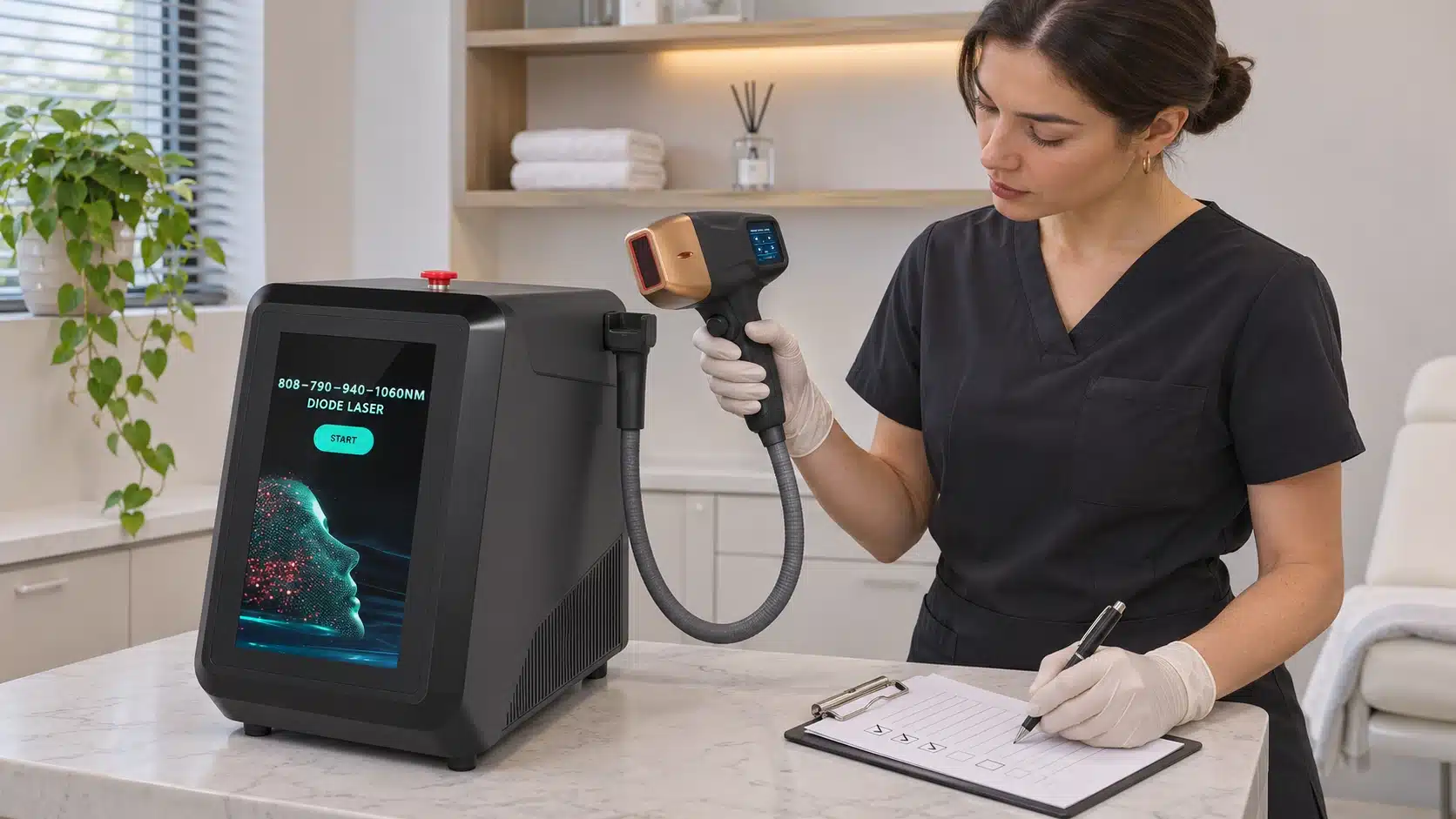
Cleaning and disinfection must follow both the device instructions and the clinic’s infection-control policy. Use only compatible agents, contact times, wipes, and methods. Prevent liquid from entering seams, connectors, ventilation openings, or optical assemblies. Do not spray fluid directly onto the machine unless the manual explicitly allows it.
Between patients, dispose of single-use items, process reusable accessories as instructed, and inspect patient-contact surfaces and delivery components. Confirm that the next accessory is correct and record unusual changes in pulse, shot, line, or cartridge counts.
At day end, follow the specified shutdown sequence. Store handpieces without tight bends, protect optical ends with the correct caps, leave cooling systems as instructed, and log faults or consumable changes.
Weekly operator review
A weekly review looks for gradual changes. Inspect accessible vents and filters, wheels and brakes, cable routing, footswitch operation, handpiece holders, caps, and external connectors. Clean only components identified as operator serviceable.
Review fault logs and ask about intermittent issues. Escalate repeated overheating, delayed handpiece recognition, unreliable footswitch response, or unexplained output warnings even if the device later starts normally.
Check approved tips, fibers, windows, filters, coolant, and caps. Separate single-use, reusable, and limited-life items and trace each one to the correct platform.
Monthly maintenance control
Each month, compare current behavior with the baseline and review unresolved faults, service messages, replaced parts, and operator reports. Confirm that staff completed the scheduled tasks using the current checklist.
Review service dates, warranty deadlines, manufacturer software notices, and critical consumables. Complete monthly coolant, filter, water-quality, or accessible-optics tasks only when the manual assigns them to operators.
Also verify the service contact, warranty-claim process, backup accessories, and parts lead times. Maintain a separate parts list for each model.
Annual and qualified service work
Professional maintenance should follow the interval defined by the manufacturer, service agreement, regulation, and usage. Annual is a planning category, not a universal rule. High-use or older systems may need service sooner.
A qualified visit may include output verification, calibration, electrical testing, internal cooling inspection, optical alignment, delivery-system checks, interlock testing, software review, and internal parts. Ask for a report identifying measurements, replaced parts, unresolved findings, and the next due date.
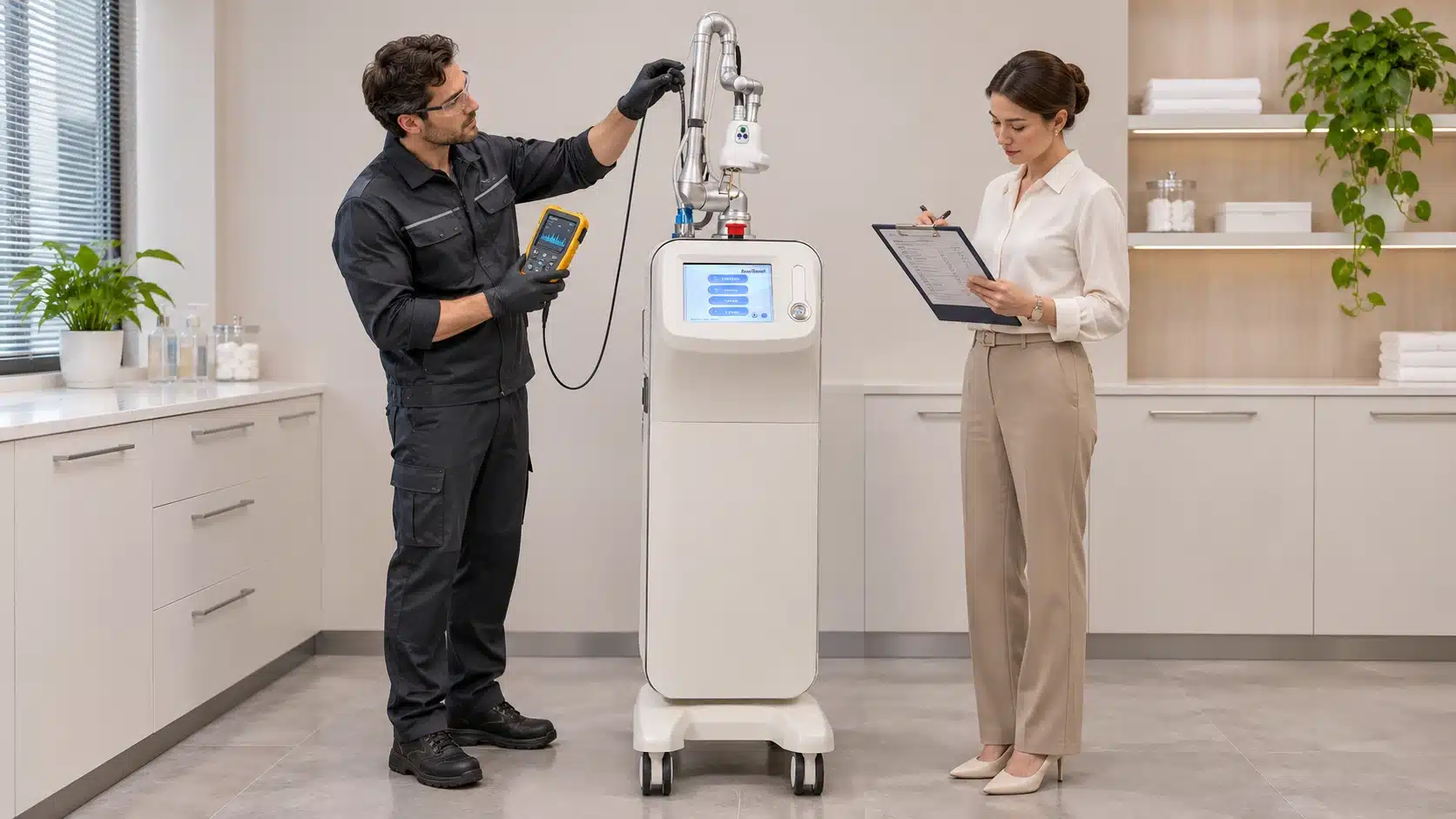
Arfurla outlines manuals, maintenance guidance, technical assistance, parts support, and warranty information on its service and support page. A buyer should confirm the terms that apply to the specific model, sales channel, country, and purchase contract before relying on a general website statement.
Adjust the checklist by device architecture
Water-cooled diode systems require attention to cooling, ambient conditions, the handpiece window, cable strain, and approved water or filter schedules. Arfurla’s article on evaluating professional laser hair removal equipment places cooling and workflow in the purchase decision.
Fiber-delivered 980 nm and 1470 nm systems need model-specific handling for fibers, connectors, handpieces, caps, and single-use accessories. Do not improvise a bent, contaminated, or damaged fiber back into service. See the 980 nm and 1470 nm laser accessory guide for compatibility checks.
Fractional CO2 systems may add scanner, articulated-arm, optical-path, plume-management, and calibration requirements. Internal mirror alignment, high-voltage components, and measured output belong to qualified service.
Multi-technology platforms need separate maintenance lines for each energy-delivery module because cleaning rules, counters, inspection points, and replacement criteria can differ.
Keep a useful maintenance log
A useful log records the date, device, task, finding, action, responsible person, and follow-up. Replace vague notes such as machine not working with the displayed code, operating stage, installed accessory, visible indicator, and approved troubleshooting result.
Track downtime, repeated faults, replaced parts, and measured service results. The history can show whether a recurring problem needs training, an accessory replacement, a facility check, or repair.
Keep requested photos and fault-code screenshots without patient information. Store service reports and warranty correspondence with the asset record.
Kesimpulan
A strong preventive maintenance program uses a simple rhythm: operators complete approved checks, managers review trends and documentation, and qualified technicians handle calibration and internal service. The checklist must stay tied to the exact model. When clinics record normal behavior, escalate changes early, and plan parts and support before a failure, they can reduce avoidable downtime without asking staff to work beyond their training.
To build a model-specific maintenance and support plan, send Arfurla the machine list, serial information, installed accessories, usage pattern, destination market, and current issue through the contact and inquiry page.
Pertanyaan yang Sering Diajukan
How often should an aesthetic laser receive preventive maintenance
Follow the exact manufacturer’s schedule, usage conditions, service agreement, and local requirements. Daily, weekly, monthly, and annual labels are planning categories, not universal intervals.
What laser maintenance can clinic staff perform
Staff can perform the external inspections, approved cleaning, visible indicator checks, startup tests, recordkeeping, and consumable handling assigned to operators in the manual and training.
When should a laser be taken out of service
Stop use for conditions such as a coolant leak, damaged power cable or fiber, smoke, unusual odor, repeated overheating, failed interlock, unexplained output warning, or a fault that the approved troubleshooting process does not clear.
Does cleaning replace preventive maintenance
No. Cleaning is one part of operator care. Preventive maintenance may also require measured output checks, calibration, electrical testing, cooling inspection, safety checks, software review, and internal service by qualified personnel.
What records should a clinic keep
Keep the asset register, manual, checklists, fault history, consumable changes, service reports, test results, parts records, warranty correspondence, and next service date.