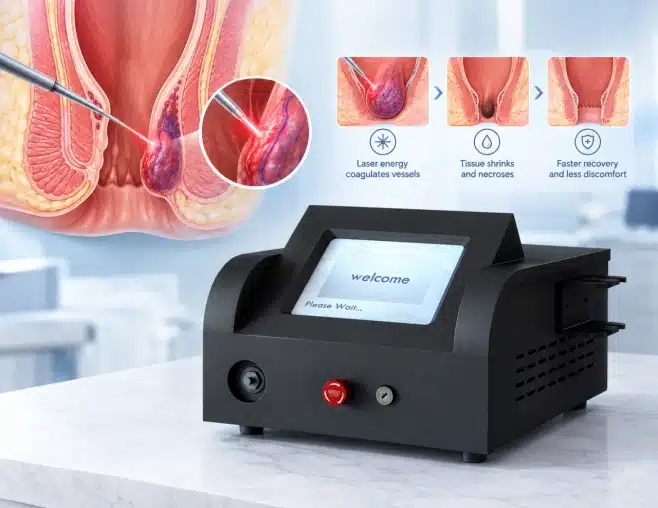
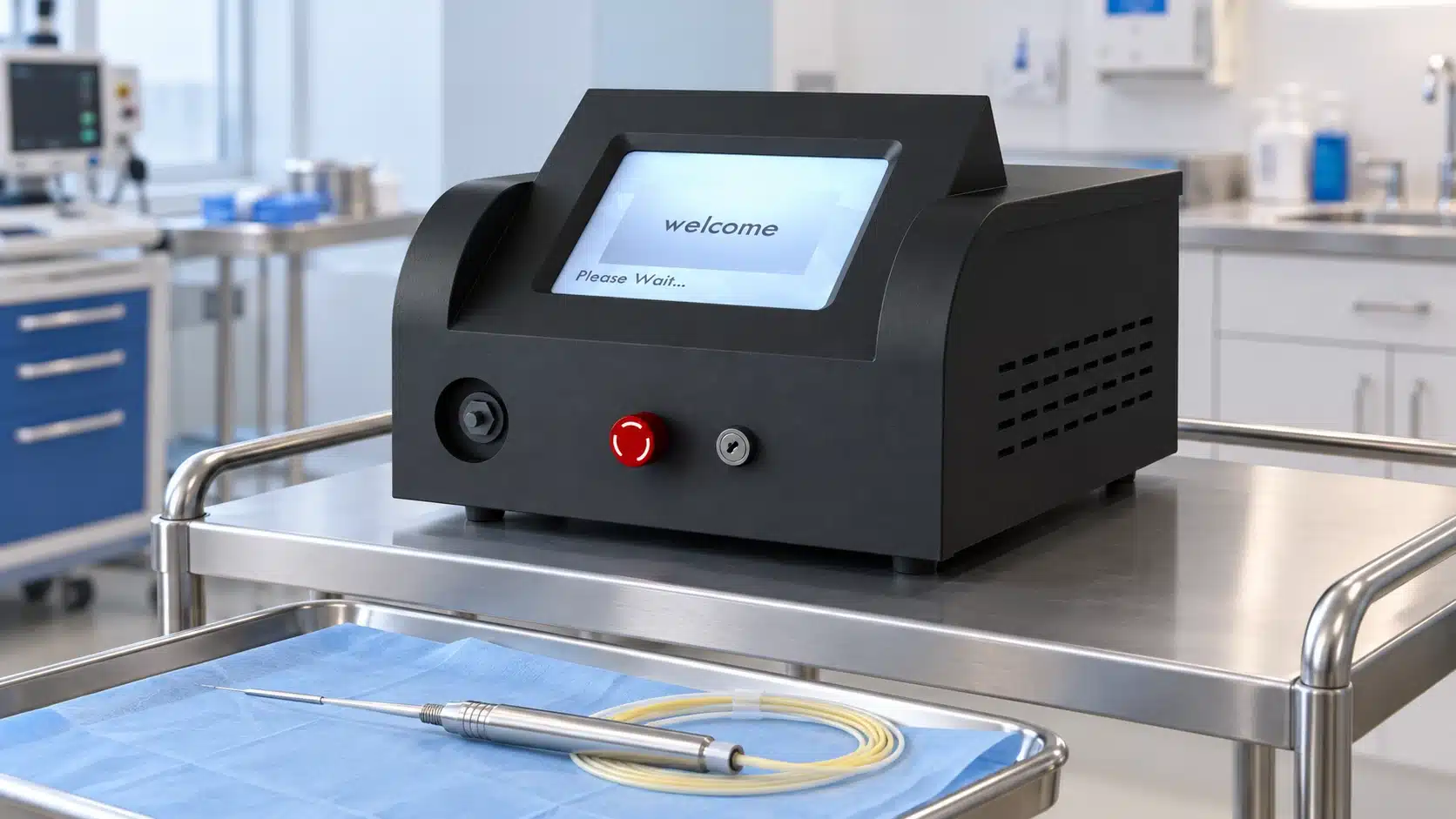
SiLaC treats selected pilonidal sinus disease by cleaning the tract and withdrawing a radial-emitting laser fiber through it to ablate the epithelial lining and contract the channel. A suitable system pairs a diode generator, commonly at 1470 nm, with a sterile radial fiber, compatible connector, introducer, laser safety accessories, and a protocol that controls power and pullback. The procedure is not appropriate for every abscess or complex tract.
What SiLaC Treats
Pilonidal sinus disease forms epithelialized tracts and pits in the natal cleft that can retain hair, debris, and inflamed tissue. SiLaC, or sinus laser-assisted closure, targets the tract from inside rather than excising a wide block of tissue. The laser step follows mechanical cleaning; it does not replace identification of all pits, branches, and cavities. Leaving hair or an untreated branch can permit persistent drainage or recurrence.
Arfurla's proctology laser application page identifies pilonidal sinus among its 1470 nm proctology applications. That confirms product relevance, while case selection and operative technique remain clinical decisions governed by the device instructions, surgeon training, and local regulation.
Patient and Disease Selection
SiLaC is most defensible when the team can map and clean the complete tract through small openings. Selection should consider:
- Chronic primary disease or selected recurrent disease without an acute abscess that first requires drainage.
- Limited or mild tract burden that can be probed and debrided. Evidence from earlier reviews was concentrated in mild chronic disease.
- The number and direction of pits, lateral extensions, prior operations, active infection, and whether endoscopic visualization or imaging is needed.
- Comorbidities that impair wound healing, including severe immunosuppression, uncontrolled diabetes, smoking, and poor ability to perform postoperative hygiene.
- A realistic consent discussion covering possible nonhealing, infection, repeat laser treatment, and conversion to an excisional or off-midline flap procedure if disease persists.
Procedure Step by Step
- Map the primary pits and all visible secondary openings. Drain an acute abscess and control infection before definitive closure when indicated.
- Position the patient prone and select local, regional, or general anesthesia according to tract complexity, patient factors, and institutional practice.
- Enlarge the access opening only enough to permit probing and removal of embedded hair and debris.
- Curette or brush the tract and irrigate until loose epithelium, granulation tissue, and foreign material have been removed. Endoscopic assistance can reveal branches that blind probing misses.
- Measure or mark the tract so the operator can plan fiber depth, pullback distance, and energy delivery.
- Insert the radial fiber to the distal end without forcing the glass tip around a tight bend or exposing it beyond the protective introducer during placement.
- Activate the laser and withdraw the fiber at a controlled, validated rate so circumferential energy reaches the tract wall. Treat each branch separately when the protocol permits.
- Inspect the openings, confirm hemostasis, apply a simple dressing, and document generator settings, total energy, fiber lot, tract length, branches, and any additional procedure.
How Radial Emission Treats the Sinus Tract
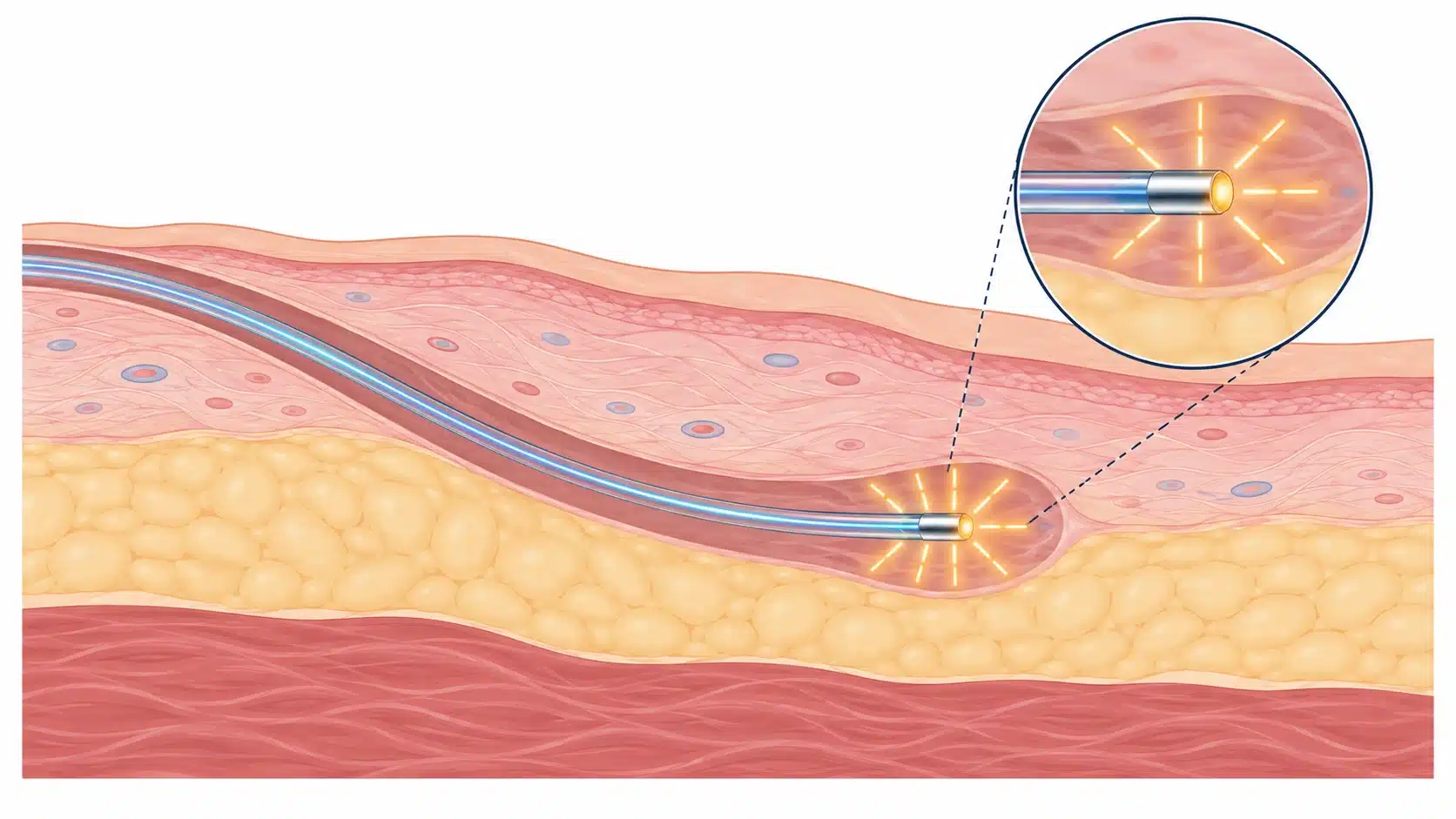
A radial tip emits laterally around the fiber rather than concentrating energy straight ahead. Circumferential delivery is intended to contact the tract wall during pullback, producing controlled thermal injury, epithelial destruction, coagulation, and tissue contraction. Even radial emission is not automatically uniform in a wide cavity, sharp branch, or debris-filled tract. Effective treatment still depends on debridement, centering, contact conditions, pullback consistency, and avoidance of stationary hot spots.
Itu Arfurla radial fiber product page lists 360-degree emission, an SMA-905 connector, a 3 m fiber, 400 or 600 micrometer diameters, and compatibility with 980 nm and 1470 nm diode lasers. The page also describes the probe as sterile and single use. A purchasing team should confirm the current instructions for use, lot labeling, shelf life, power limit, intended SiLaC application, and available introducer before relying on any web specification.
Matching the Fiber Generator and Accessories
Compatibility is a system question. The following checks should be completed together rather than one at a time.
| Component | Verify | Why it matters |
| Generator | 1470 nm output, mode, power range, energy display, footswitch, interlock | The protocol must be reproducible and compatible with the fiber instructions |
| Laser fiber | Radial emission, SMA-905 connector, 400 or 600 micrometer option, 3 m length, sterile single use | Connector fit and optical geometry determine delivery and handling |
| Access tools | Probe, brush or curette, cannula or introducer, tract gauge, optional fistuloscope | The tract must be cleaned and the glass tip protected during placement |
| Safety | Wavelength-rated eyewear, warning controls, smoke management when required, fiber inspection | These controls reduce avoidable staff and patient hazards |
| Documentation | IFU, training record, fiber lot, settings, total energy, service and calibration records | Traceability supports quality review and incident investigation |
Arfurla's 980 nm and 1470 nm diode laser platform is presented for multiple medical applications. A multipurpose platform still requires an application-specific accessory set and protocol. Do not infer that a connector alone proves optical, thermal, regulatory, or sterile compatibility.
Clinical Evidence and Limits
A 2026 systematic review and meta-analysis included 29 studies and estimated an 86% cure rate, 11% recurrence rate, and 10% complication rate for SiLaC. The analysis found broadly comparable pooled outcomes for EPSiT, but it was an indirect comparison of predominantly single-arm studies. Heterogeneity was high, and the authors called for prospective direct comparisons. These pooled figures are useful for counseling but should not be presented as a guaranteed result for a specific device or disease pattern.
A 2025 SiLaC plus EPSiT cohort reported 83 patients, mean operative time of 25 minutes, mean healing of 17.3 days, and 3.6% recurrence at six months. Endoscopy found previously undetected branches in 9.6% of cases, illustrating why anatomy and debridement matter. The study was retrospective, single-center, combined two techniques, and had limited follow-up, so its results cannot be assigned to SiLaC alone.
Postoperative Care and Failure Signals
Many SiLaC protocols allow same-day discharge with a small open access point. The surgeon’s instructions should address dressing changes, showering or irrigation, cleft hygiene, analgesia, activity, hair control, and follow-up. Hair removal strategies should be individualized; laser hair removal is a separate intervention and should not be confused with tract ablation.
- Review persistent drainage, recurrent swelling, fever, worsening pain, or a new abscess promptly.
- Confirm epithelialization clinically rather than using early symptom relief as the only endpoint.
- Reassess for an untreated branch, retained hair, or an inadequately drained cavity when healing stalls.
- Discuss repeat minimally invasive treatment versus an off-midline excisional or flap approach when recurrence occurs.
Scope and Limitations
SiLaC is attractive because it preserves tissue and may reduce wound-care burden, but limited access is also its constraint. Extensive branching, a large chronic cavity, active abscess, inability to debride the full tract, or repeated failure may favor endoscopic assistance or another operation. Equipment should support the selected procedure; it should not drive the indication. Clinics must also verify local regulatory clearance, sterile supply continuity, training, maintenance, and backup plans before launching a service.
Kesimpulan
A reliable SiLaC program combines disciplined case selection, complete tract cleaning, a compatible radial fiber, controlled pullback, and structured follow-up. Arfurla publishes a 360-degree SMA-905 radial fiber in 400 and 600 micrometer options for use with its diode platform, but the clinical team should confirm the current IFU and full accessory chain for the intended market. To evaluate a configuration, request application support with the planned wavelength, tract access method, fiber diameter, introducer, case profile, sterile-use policy, and destination country.
Pertanyaan yang Sering Diajukan
What does SiLaC stand for
SiLaC commonly means sinus laser-assisted closure. The tract is mechanically cleaned, then laser energy is delivered from inside to ablate and contract the lining.
Why is a radial fiber used
A radial fiber emits laterally around the tip, which supports circumferential treatment during pullback. It does not replace tract mapping, cleaning, or treatment of each branch.
Is 1470 nm required
Many published SiLaC protocols use a 1470 nm diode laser because of its interaction with water-rich tissue. The wavelength, fiber, settings, and technique must be validated as a system; clinics should not substitute parameters across devices.
Can SiLaC treat an acute pilonidal abscess
An acute abscess generally requires drainage and infection control first. Definitive SiLaC may be considered later after anatomy and disease burden are reassessed.