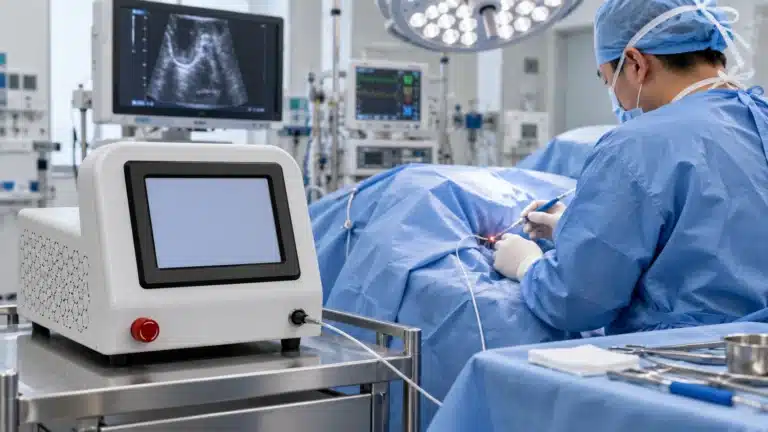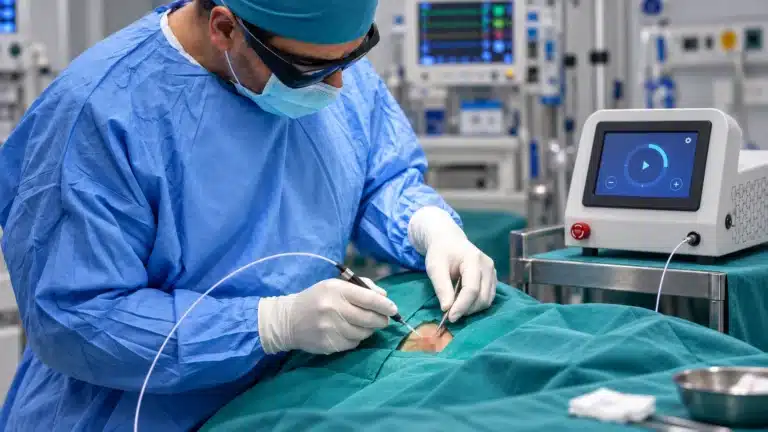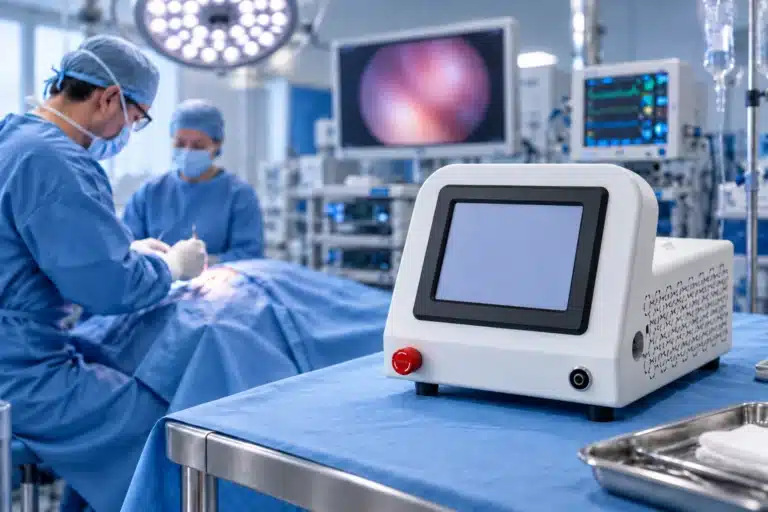
Varicose veins are more than a cosmetic concern. Chronic venous disease may cause aching, heaviness, swelling, skin changes, bleeding, thrombosis, and venous ulceration. Endovenous laser ablation, also called endovenous laser treatment (EVLT) or endovenous laser ablation therapy (EVLA), is an established minimally invasive option for treating superficial venous reflux. Current vascular guidelines emphasize duplex ultrasound assessment and evidence-based treatment selection.
For distributors, importers, wholesalers, and procurement teams, a complete EVLT solution involves wavelength, fiber design, compatible accessories, training, regulatory documentation, consumable supply, and technical support.
What Is Endovenous Laser Ablation?
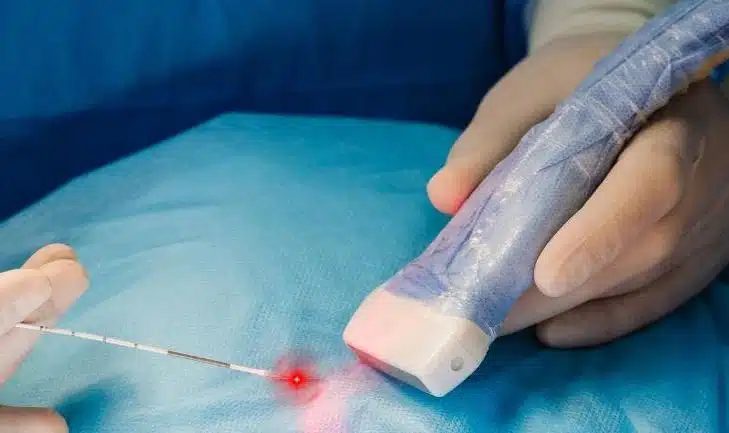
Endovenous laser ablation is a catheter-based procedure that uses controlled thermal energy to close an incompetent superficial vein. Under ultrasound guidance, a clinician advances an optical fiber into the target vessel. Laser energy heats the vein wall, producing contraction and closure. Blood is redirected through functioning veins, while the treated vessel is gradually fibrosed and absorbed.
EVLT is commonly used for the great saphenous vein, small saphenous vein, and selected accessory veins. It is performed by appropriately trained and credentialed clinicians.
Key Characteristics of EVLT
- Minimally invasive percutaneous access
- Duplex ultrasound guidance
- Local or tumescent anesthesia
- Controlled intravascular laser delivery
- Outpatient treatment in suitable settings
Clinical reference paper highlights the same fundamental principle, whereby the laser energy is emitted into the abnormal vein using a catheter, thereby ensuring the closure of the vein and rerouting the blood flow through healthy veins.
What Happens During Endovenous Laser Ablation?
Although protocols vary by clinician, anatomy, device, and local regulation, the procedure usually follows a standard sequence.
1. Duplex Ultrasound Mapping
Ultrasound confirms reflux, vessel anatomy, diameter, access location, and the relationship between superficial and deep veins. Modern guidelines identify duplex scanning as a central element of evaluating superficial truncal reflux.
2. Venous Access and Fiber Placement
The target vein is accessed with a needle or introducer sheath. A catheter and laser fiber are advanced under ultrasound guidance and verified before energy delivery.
3. Tumescent Anesthesia
Tumescent fluid may be placed around the vein to provide anesthesia, compress the vessel around the fiber, and create thermal separation from surrounding tissue.
4. Laser Energy Delivery
Activation of the laser takes place as the fiber is retracted at a particular rate. The wavelength, power, pull back rate, vessel size, and fiber shape affect energy delivery. Arfurla has documented one design based on the 1470nm wavelength with a 600μm radial fiber.
5. Compression and Follow-Up
The access site is dressed, and follow-up ultrasound may confirm closure and assess complications. Potential risks include pain, bruising, burns, nerve irritation, thrombophlebitis, deep vein thrombosis, or thrombus extension.
When Is This Treatment Appropriate?
EVLT is indicated for varicose veins in cases where there is superficial venous reflux, especially where an incompetent truncal vein is seen on the ultrasound.
Conservative treatment options are physical activity, elevation of legs, weight control, and compression therapy.
Anatomical considerations, symptoms, co-morbidities, personal choice, physician’s preference, and availability of technology determine which option to choose.
In terms of sales for manufacturers, the clinical indication is a determinant of positioning of their products. The EVLT technology should be advertised as a professional medical device.
The selling material should distinguish the application, compatible fiber, accessory requirements, end user, contraindications, and regulation within each jurisdiction.
Is Endovenous Laser Ablation Appropriate for Every Patient?
EVLT is not applicable in all cases. Acute thrombosis, venous occlusion, infections, pregnancy, significant coagulation problems, or abnormal anatomy could call for further assessment.
Content for B2B must stay away from assured results, broad applicability, or assertions of pain-free treatments. Good suppliers offer information on operations, risks, training materials, and proper application details without claiming diagnosis or treatment.
What Should Distributors Evaluate in an EVLT Laser System?
Wavelength and Fiber System
A 1470nm diode laser is widely used for EVLT because water absorption supports localized heating of the vein wall. Dual-wavelength platforms may also include 980nm for broader vascular or surgical applications. Arfurla presents a multifunction platform with 650nm, 980nm, and 1470nm options and 12 clinical functions.
A complete package should define radial fiber diameter, emission pattern, connector type, introducer compatibility, sterile packaging, shelf life, and reorder availability. Arfurla lists a 600μm radial fiber and introducer catheters for EVLT.
Controls, Documentation, and Support
Procurement teams should review operating modes, power adjustment, emergency controls, manuals, labeling, safety reports, quality-system certificates, device registration evidence, and market-specific regulatory files. Final specifications should be confirmed because configurations may vary.
Arfurla states that it operates an in-house R&D department and factory, provides OEM/ODM services for global distributors, and offers a two-year warranty with ongoing technical support. Installation videos, maintenance guidance, troubleshooting, and spare-parts support are also described.
Arfurla 980nm 1470nm Çok Fonksiyonlu Tıbbi 12'si 1 Arada Diyot Lazer Cihazı
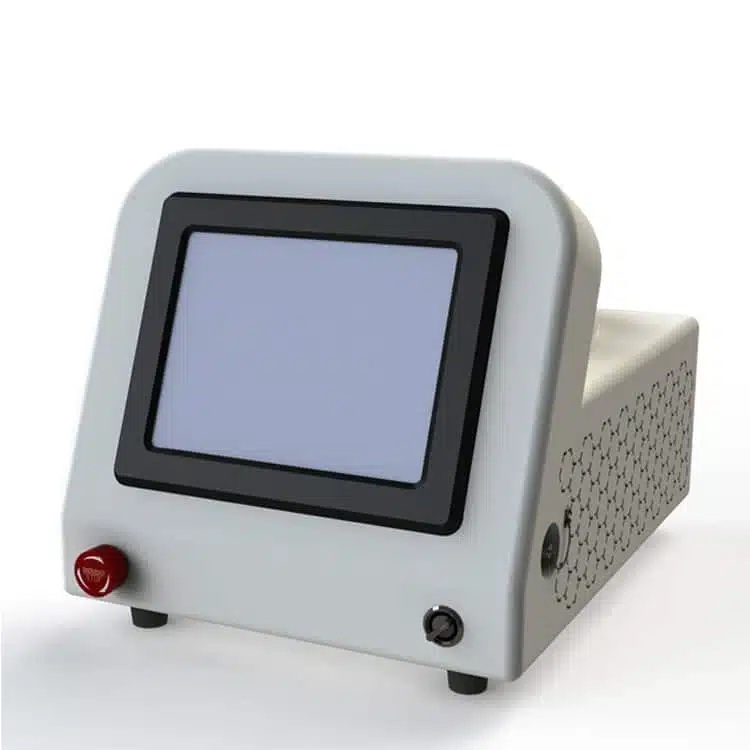
O Arfur ile birlikte platform combines EVLT with endolaser and lipolysis, physiotherapy, vascular, proctology, ENT, gynecology, dentistry, PLDD, soft-tissue surgery, and veterinary applications. This may help distributors address several segments with one product family, subject to local approvals.
EVLT procurement discussions should cover the 1470nm configuration, radial fibers, introducer sets, consumable pricing, minimum order quantity, branding options, training materials, warranty terms, and regulatory documents.
Arfurla’s official profile identifies the company as a developer, manufacturer, seller, and after-sales service provider with its own factory and OEM/ODM capability. An independent B2B listing also describes Hangzhou Arfurla as a diode laser and medical or beauty equipment manufacturer.
SSS
What Is the Difference Between EVLT and EVLA?
EVLT and EVLA generally describe the same endovenous laser technique. Terminology varies by market, clinic, publication, and product category.
Why Is 1470nm Commonly Used for EVLT?
The 1470nm wavelength has strong absorption in water-rich tissue, supporting controlled energy delivery to the vein wall. Device settings and clinical technique determine the final thermal effect.
What Accessories Are Normally Required?
Typical sets include a radial fiber, introducer, guidewire, sheath or catheter, eyewear, and procedure-specific disposables. Contents must be confirmed with the supplier.
Can One Diode Laser Support Multiple Departments?
A multifunction platform can support several applications when compatible fibers, handpieces, software, training, and regulatory clearances are available.
What Should a Distributor Request Before Ordering?
A complete review should include specifications, accessories, consumable pricing, warranty, training, OEM/ODM options, delivery schedule, and device-specific compliance documents.
Partner with an EVLT Laser Manufacturer, Supplier, and Factory
Hangzhou Arfurla Science & Technology Co., Ltd. positions itself as a medical and aesthetic laser manufacturer, supplier, and factory serving distributors, importers, wholesalers, clinic groups, and procurement organizations.
O 980nm/1470nm Multifunction Medical 12 in 1 Diode Laser Machine can be configured for EVLT and additional clinical applications, with OEM/ODM cooperation, accessory supply, technical training, and after-sales support available for B2B projects.
For product specifications, distributor pricing, demo discussions, customization, regulatory files, and shipping terms, procurement inquiries can be submitted through Arfurla’s official contact channel de info@arfurla.com veya +86-1830-1023-578.