A 7-in-1 aesthetic platform is suitable for a clinic only when its modules match services the clinic can staff, schedule, support and sell consistently. The function count is not the decision. The real test is whether the platform simplifies delivery of a defined treatment menu without creating idle handpieces, excessive consumable cost or avoidable room turnover.
For most clinics, that decision starts with a service-mix audit and ends with a documented configuration, training plan and ownership-cost estimate. A multifunction beauty machine may reduce the number of consoles in a room, but consolidation is useful only if each selected modality has a clear role in the patient journey and a practical operating owner.
Start with the Clinic’s Service Mix and Target Clients
List current revenue-producing services, frequently requested services the clinic cannot yet deliver, and services planned for the next 12 to 24 months. Separate recurring demand from occasional inquiries. A clinic focused on facial tightening may value ultrasound and radiofrequency modules differently from a center building body-contouring packages or combining treatment and post-procedure cooling.
Then define the intended client groups and the treatment journey for each one. Record the concern being addressed, the clinician or operator responsible, the expected appointment length, the room required, and any follow-up or complementary service. This converts a broad aesthetic equipment buying guide into a clinic-specific operating model. If a module cannot be assigned to a real service, trained operator and realistic appointment pathway, treat it as optional rather than as value already captured.
- Core modules: needed for services the clinic already performs or is prepared to launch.
- Growth modules: supported by documented demand, staffing and a launch plan.
- Non-priority modules: attractive in theory but unsupported by current workflow or target clients.
Map Each Service to a Module and Treatment Head
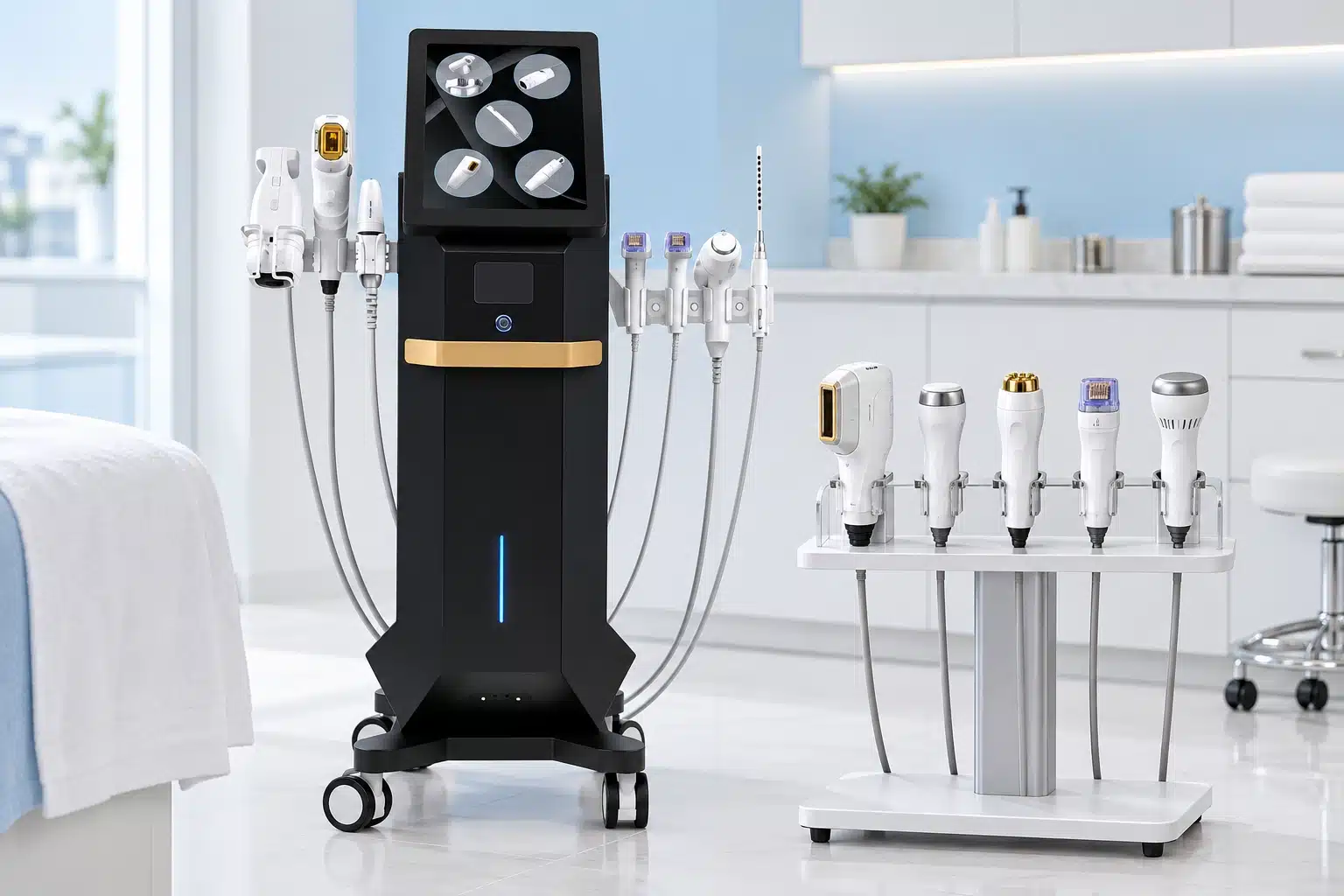
The official Arfurla 7-in-1 multifunction platform groups ICE HIFU/Vmax, Liposonic, EMRF, M8 RF microneedling and an ICE Hammer on one console. Clinics should evaluate those as separate workflows rather than assume that one team member, one protocol or one room setup covers all of them.
ICE HIFU and Vmax
Focused-ultrasound services require the clinic to confirm the supplied treatment heads or cartridges, their intended treatment areas, replacement life, system recognition and operator training. Multi-row and mobile single-point approaches may support different treatment plans, but the clinic should validate the exact configuration instead of assuming every head is included. A separate HIFU skin-tightening overview can explain the technology; the purchasing decision should focus on available heads, protocol control and serviceability.
Liposonic and EMRF
Body-focused ultrasound and monopolar RF can broaden a service menu, but they also change room time, positioning, consumables and staff competency. Ask which probes are standard, which are optional, how they are cleaned, and whether the intended body or facial protocols fit the clinic’s scope. Do not build a revenue forecast from a module name alone. Build it from bookable services, qualified staff, realistic utilization and documented operating requirements.
M8 RF Microneedling and ICE Hammer
RF microneedling adds a minimally invasive workflow with interchangeable tip configurations, while a cold-compress handpiece may support comfort or post-treatment workflow where appropriate. The clinic should clarify which tips are single-use, how they are packaged, how many are included and how replenishment works. Compare the integrated M8 module with the clinic’s current RF microneedling equipment so duplicate capability, protocol conflicts and inventory requirements are visible before purchase.
Build a Written Configuration Sheet Before Comparing Prices
Request a line-by-line configuration rather than a single package label. The sheet should identify the console, software version, every handpiece, probe or cartridge, included quantities, optional items, treatment-area limitations, expected service life, storage requirements and replacement part numbers. For any disposable tip or cartridge, confirm unit cost, minimum order quantity, lead time and whether alternatives are permitted.
Use the same sheet for every supplier comparison. A lower quoted price may exclude frequently used heads, starter consumables, training or freight. A higher quote may include items the clinic does not need. Normalizing the configuration prevents the team from comparing unlike packages and makes later acceptance testing much easier.
Calculate the Full Cost of Ownership
Capital price is only one cost. Model replacement cartridges or tips, cleaning materials, preventive maintenance, software or service charges, staff training time, shipping for repairs and revenue lost during downtime. Where a consumable has a limited number of treatments or cycles, ask for the counting method and the conditions that affect usable life. If the supplier cannot provide a reliable figure, test a conservative range rather than inserting an optimistic assumption.
The useful comparison is cost per deliverable appointment at realistic utilization. Include no-show rates, treatment-room occupancy and the time needed to switch between modules. A multifunction platform can be economical at moderate volume, but a clinic that mainly uses one modality may find a dedicated system easier to staff and maintain.
Run a Workflow Simulation in the Treatment Room
Before approval, conduct a dry run with the intended operators. Move the platform into position, attach and remove each required handpiece, place accessories on a clean surface, and simulate cleaning, storage and turnover. Check cable reach, cart movement, screen visibility, power access, ventilation, foot controls and the risk of mixing used and unused consumables. Time the change from one service configuration to another.
The simulation should also test scheduling logic. If two popular services need the same console at the same time, the platform becomes a bottleneck. If the unit moves between rooms, assign responsibility for transport, setup checks and end-of-day storage. These operating details often determine whether consolidation improves workflow or merely concentrates risk in one device.
Verify Training, Governance and After-Sales Support
Training should be modality-specific. Confirm who may operate each function, what prior qualifications are expected, whether training is live or remote, how competency is documented, and what happens when staff change. The clinic also needs approved cleaning instructions, pre-use inspection steps, incident escalation, treatment records and a method for controlling protocol revisions.
Ask the supplier to define installation, onboarding, troubleshooting, remote support, spare-part supply, repair turnaround and warranty exclusions in writing. Arfurla presents service and after-sales support as part of its offering, but a buyer should still confirm the exact support package for the quoted model, destination market and selected accessories.
Use a Simple Go or No-Go Decision
A 7-in-1 aesthetic platform is a strong candidate when several included modules support priority services, trained staff can use them, consumables are predictable, room turnover is manageable, and the supplier can support the full configuration. It is a weak fit when the clinic needs only one core technology, cannot verify recurring accessory supply, or would create a single point of failure for too many appointments.
The final decision memo should record the chosen configuration, excluded modules, assumptions behind utilization, training owners, launch dates and the conditions that would trigger a future expansion. This keeps the purchase tied to clinic strategy rather than to the longest feature list.
Conclusión
Clinics should evaluate a 7-in-1 aesthetic platform as an operating system for a defined service mix. Match each module and treatment head to a real appointment, normalize the quoted configuration, model consumables and downtime, test room workflow, and confirm training and support. When those elements align, a multifunction platform can consolidate useful capability. When they do not, fewer well-used modalities may be the better investment.
Preguntas frecuentes
Is a 7-in-1 platform automatically more cost-effective than separate devices?
No. Cost-effectiveness depends on utilization, included accessories, consumable life, maintenance, staffing and downtime. Compare cost per realistic appointment, not cost per listed function.
Which treatment heads should a clinic order first?
Prioritize heads tied to current or launch-ready services. Confirm treatment area, compatibility, included quantity, replacement cost and training before adding optional heads.
How should a clinic estimate consumable demand?
Forecast monthly appointments by modality, multiply by the consumables required per appointment, add a reasonable safety stock and account for supplier lead time and shelf-life conditions.
What information should be included in an RFQ?
Include the planned services, target treatment areas, required modules and heads, expected monthly volume, operator roles, room constraints, training needs, destination market and requested support terms.
Request a Configuration Review
For a documented fit check, request a configuration review with your planned services, preferred modules, target treatment areas, expected volume, staff experience and delivery market.