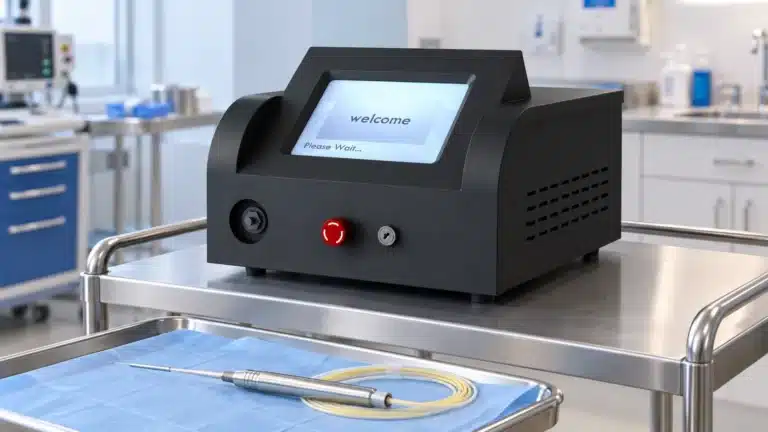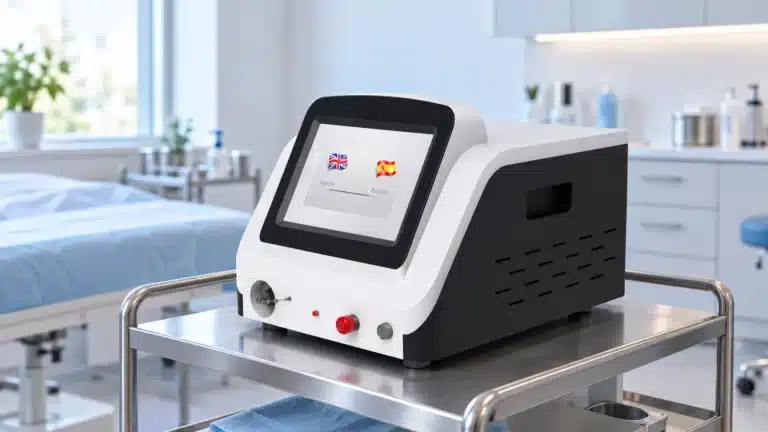
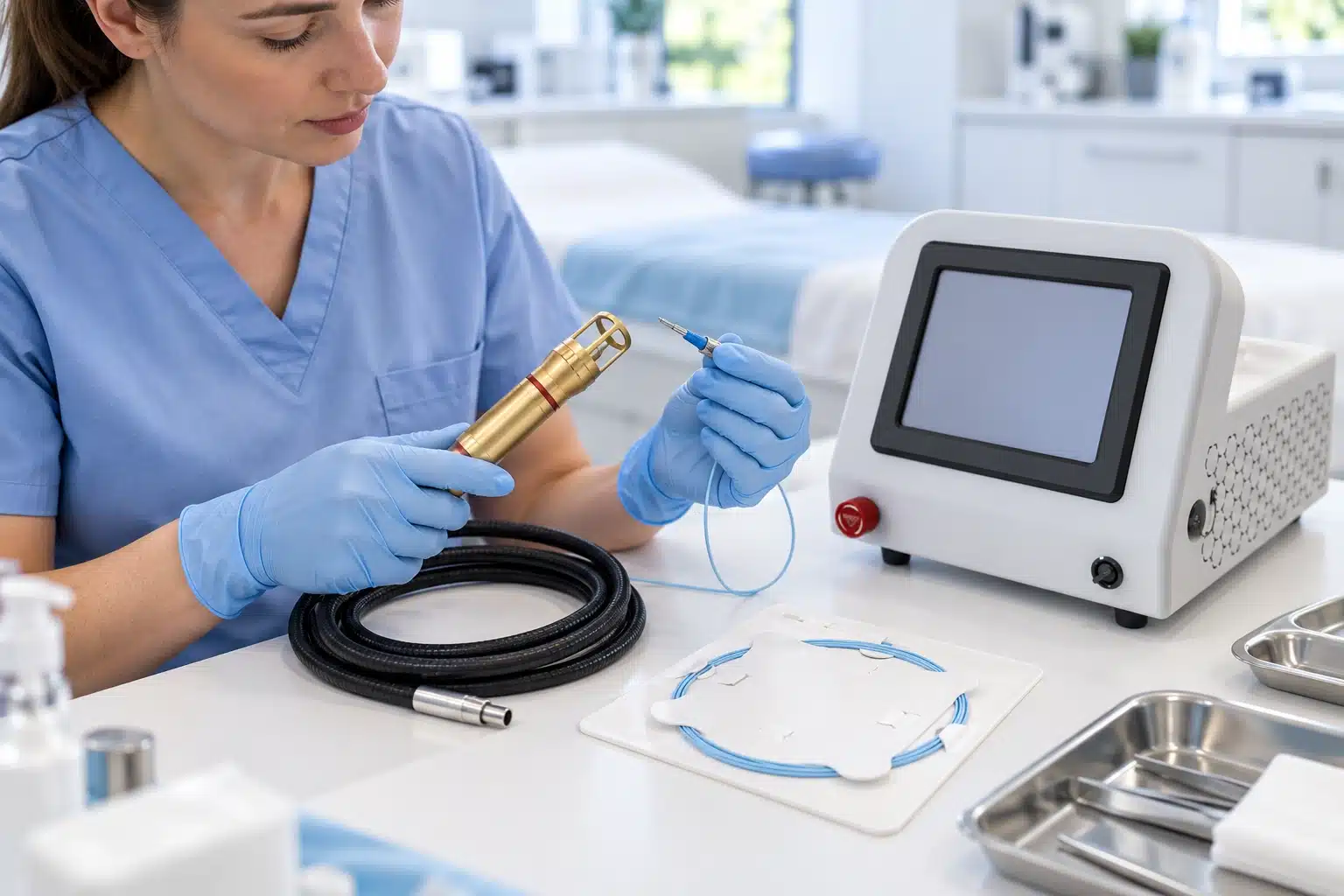
Choose 980/1470nm laser accessories from the host system and intended procedure outward. Start with the exact laser model, enabled wavelengths, output modes and connector specification; then select the fiber geometry, diameter and handpiece that the manufacturer has documented for that combination. A matching wavelength label is not proof of mechanical, optical or clinical compatibility.
This approach is especially important when a purchasing team is building a mixed accessory set for several departments. The 980nm and 1470nm laser accessories catalog includes bare, conical and radial fibers plus handpieces for multiple specialties. The useful buying task is to convert that catalog into a controlled, model-specific bill of materials.
Build a Compatibility Record Before Ordering
Create one compatibility record for every host laser. Capture the manufacturer, exact model, serial or hardware revision where relevant, installed software, available wavelengths, supported operating modes, connector type and any stated limits for fiber diameter, power, pulse energy or duty cycle. Attach the current instructions for use and accessory list rather than relying on a sales description.
For each proposed fiber or handpiece, record the part number, connector, core and outer diameter, distal-tip geometry, usable length, sterility status, single-use or reusable designation, reprocessing method, packaging quantity and expiration conditions. Mark every unknown field for written supplier confirmation. Compatibility should be approved as a specific host-accessory pair, not as a general claim that a part works with 980nm or 1470nm lasers.
Understand the Main Fiber Categories
Fiber geometry changes how energy exits the distal end and how the operator positions the delivery component. The procedure, access path, target tissue, visualization method and validated operating parameters should therefore drive selection. The descriptions below are category-level distinctions, not treatment instructions.
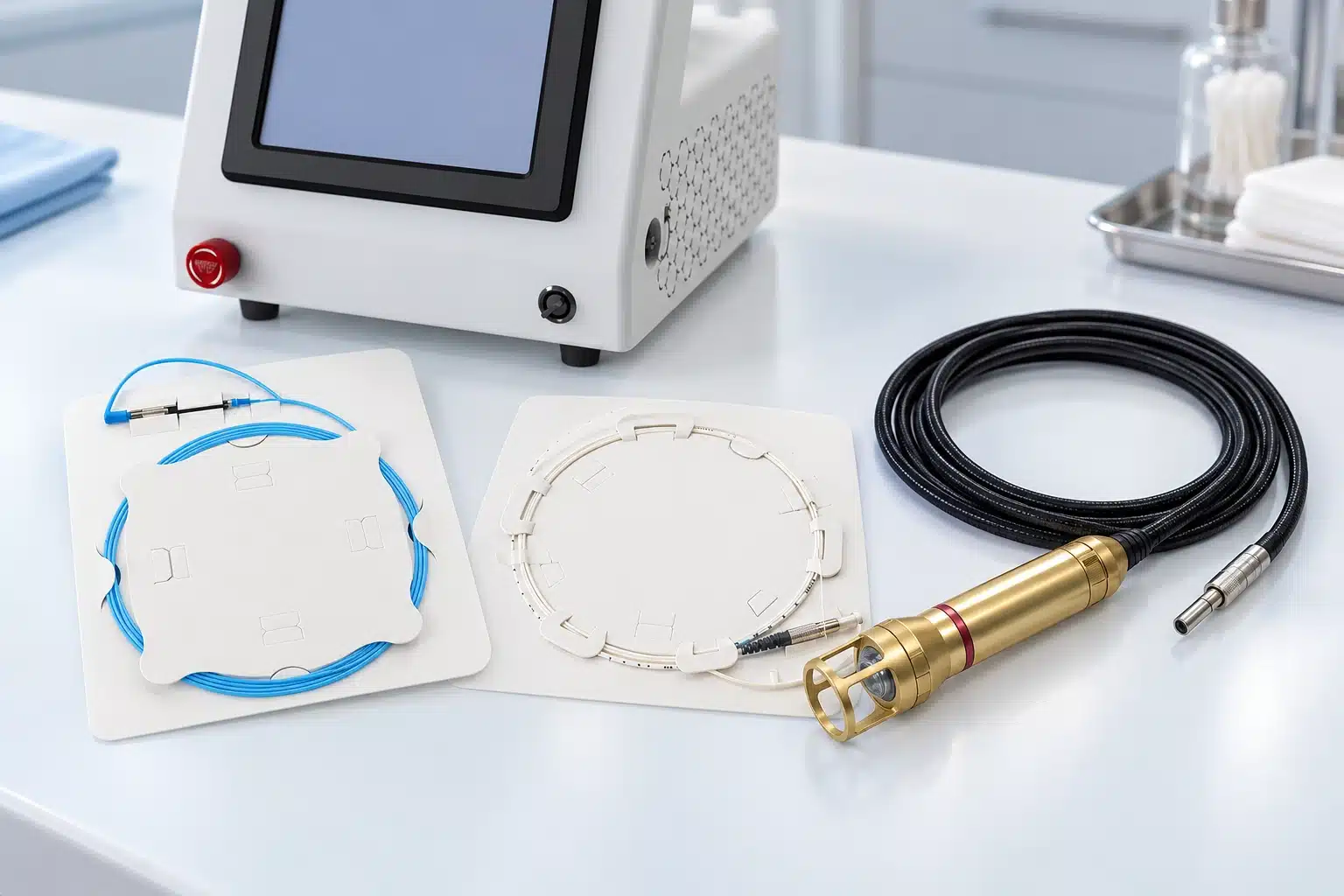
Bare or Straight Fibers
A bare fiber generally delivers energy forward from an exposed distal end. Buyers should verify the core diameter, outer diameter, numerical aperture or equivalent optical specification, connector, tip preparation, minimum bend limits and whether the fiber is supplied ready to use. Also confirm whether the intended handpiece holds that diameter securely and whether the host system recognizes or permits the accessory at the planned output.
Conical Fibers
A conical tip changes the distal geometry and may alter the emission pattern or contact behavior. Do not treat every conical fiber as interchangeable. Ask for the exact drawing or specification, intended procedure family, compatible handpiece, allowed wavelength and operating range, packaging status and replacement part number. If the supplier cannot identify the specific host models covered by its documentation, the compatibility review is incomplete.
Radial and Two-in-One Fibers
Radial fibers are designed to distribute energy around the distal region rather than only straight ahead. A radial fiber option may be listed for a 980/1470nm platform, but buyers should still confirm the emission geometry, active length, markings, sheath dimensions, connector, procedure-specific documentation and whether the item is single-use. A two-in-one design also needs a clear explanation of each functional section and its compatible workflow.
Match Handpieces to the Intended Department
A handpiece helps guide, stabilize or position a compatible fiber and may organize procedure-specific tips or attachments. It does not make an unsupported fiber compatible. Map every handpiece to the host, fiber, department, cleaning method and operator workflow before it enters the purchasing list.
- Lipolysis or liposuction: confirm the compatible cannula or guide, fiber diameter, insertion and cleaning workflow, and every disposable component.
- Vascular or EVLA: verify the documented radial-fiber combination, introducer compatibility, markings, sterile packaging and the facility’s procedure protocol.
- Proctology: match the fiber and handpiece with the intended access device, such as an anoscope, and confirm the complete sterile or reusable pathway.
- Podiatry or nail applications: verify the treatment tip, beam delivery method and host settings supported by the manufacturer.
- Physiotherapy: confirm whether the applicator is contact or non-contact, its spot configuration, cleaning method and compatibility with the host’s therapy modes.
- Gynecology, soft-tissue and ENT: document the access route, viewing equipment, fiber support, sterilization or reprocessing steps and department-specific training.
- Dentistry: check tip type, fiber retention, sterilization and procedure scope. A listed dental laser handpieceshould still be approved against the exact laser and disposable-tip system.
Treat Connector Labels as the Start of the Check
Connector names such as SMA905 or FC describe only part of the interface. Two accessories can share a connector family yet differ in ferrule dimensions, keying, optical alignment, fiber core, protective jacket, maximum supported output or end-face preparation. The host may also use an interlock, calibration file, recognition feature or accessory-specific operating limit.
Ask the supplier to confirm the complete optical and mechanical interface in writing. A purchasing team evaluating a 980nm and 1470nm diode laser platform should request the current compatible-accessory table for the exact model, not rely on photographs or the fact that the plug appears to fit. Never power a questionable combination merely to test it.
Separate Consumables From Reusable Components
Classify every item as single-use, limited-use or reusable according to the manufacturer’s documentation. For single-use fibers and tips, confirm sterile-barrier integrity, lot traceability, storage conditions, expiration date, pack size and disposal requirements. For reusable components, obtain validated cleaning, disinfection or sterilization instructions, inspection criteria and any stated reuse limit.
The distinction affects both safety and cost. A low unit price can be misleading if the clinic needs several diameters, specialty tips and backup stock. A reusable item can also be expensive if reprocessing equipment, turnaround time or inspection requirements are overlooked. Include these factors in cost per procedure and in the department’s standard operating procedure.
Plan Spares and Inventory by Procedure
Create a small procedure kit list for each department. It should show the primary fiber, compatible handpiece, introducer or access tool, required disposable items, protective components and an approved backup. Set reorder points from monthly case volume, supplier lead time, shelf life and the consequences of a delayed case. Do not mix visually similar fibers in the same bin without clear labels and part-number control.
Track failure and replacement reasons as well as consumption. Repeated damage may indicate handling, storage, bending, connector contamination or a mismatch between the fiber and workflow. The existing 980nm minimally invasive surgery guide provides application context; the accessory record should remain the authoritative source for what is stocked and approved locally.
Use a Written Supplier Confirmation Checklist
Before issuing a purchase order, request a signed or otherwise traceable response covering the host model, wavelength, connector, fiber dimensions, tip geometry, compatible handpiece, intended-use documentation, sterility or reprocessing status, included quantity, replacement lead time, training, warranty treatment and regional documentation. Ask for current manuals and photos that show labels and connectors, but treat written specifications as the controlling evidence.
For Arfurla accessories, use the catalog to identify candidates, then ask the technical team to produce a model-specific list. The catalog breadth is useful for procurement planning across lipolysis, vascular, nail, physiotherapy, gynecology, soft-tissue, ENT and dental workflows, but the final selection should be narrower and tied to the clinic’s actual procedures.
Conclusion
A reliable 980/1470nm accessory purchase begins with compatibility evidence, not with a wavelength match or a familiar connector. Define the host, procedure and department; select the fiber geometry and handpiece; verify optical and mechanical limits; classify consumables and reusable parts; and build a documented spare plan. That process turns a broad accessory catalog into a controlled configuration the clinic can train, stock and maintain.
FAQ
Can any SMA905 or FC fiber be used with a compatible-looking laser port?
No. The connector family alone does not confirm alignment, fiber dimensions, output limits, recognition features or intended use. Obtain written host-accessory compatibility.
How should a clinic choose between bare, conical and radial fibers?
Choose from the intended procedure, required emission geometry, access path, compatible handpiece and manufacturer-validated operating range. Do not substitute one geometry for another without approval.
Which accessory details belong on a purchase order?
Include the exact part number, connector, diameter, length, tip geometry, sterile or reusable status, pack quantity, compatible host model and requested documentation.
How much backup stock is appropriate?
Base stock on procedure volume, delivery lead time, shelf life, failure history and the operational impact of a missing item. Keep only approved substitutes.
Confirm the Accessory Configuration
For a compatibility review, contact the Arfurla technical team with the laser model, enabled wavelengths, connector specification, planned procedures, required fiber diameters or tip geometries, handpiece needs, quantities and destination market.