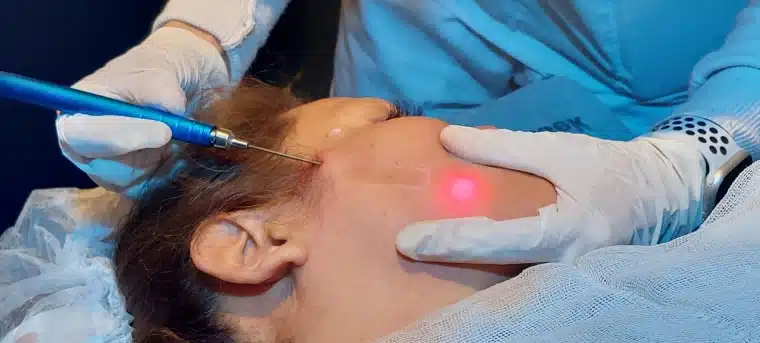
A 980nm + 1470nm fiber laser supports endolift and laser lipolysis because the two wavelengths interact with subdermal tissue in complementary ways. 1470nm is strongly absorbed by water and tends to create a concentrated thermal field close to the fiber path. 980nm interacts with hemoglobin as well as water and can produce a broader thermal effect with coagulative support. Through a fine optical fiber, energy can be planned around tissue layer, vascularity, fat distribution, and the clinical objective.
This combination is relevant to clinics, distributors, and OEM/ODM buyers evaluating endolaser equipment. It can support fat reduction, tissue contraction, skin tightening, and bodylift procedures, subject to configuration, fiber design, parameters, training, and local requirements.
How 980nm and 1470nm Interact with Tissue
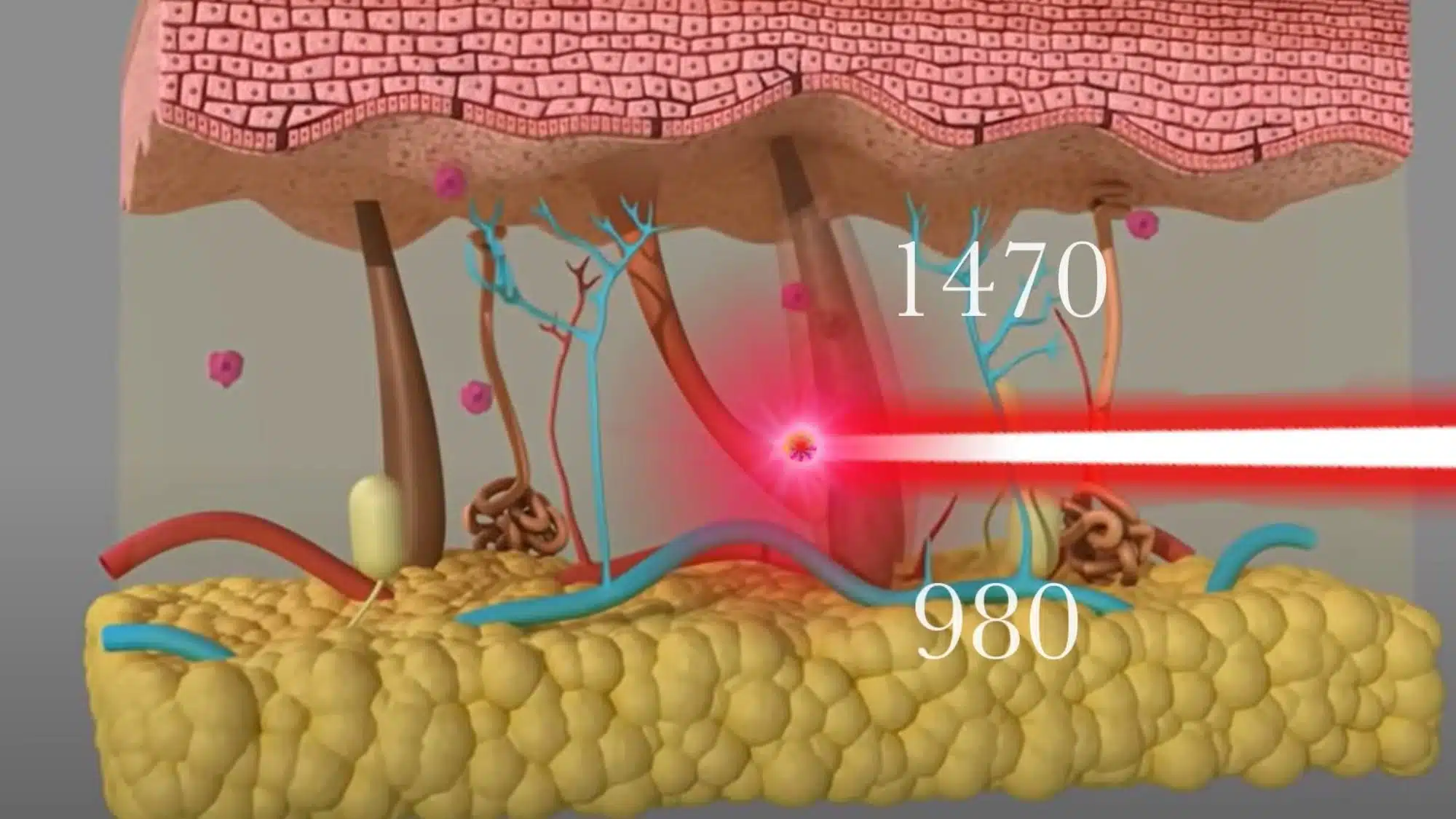
Laser energy is converted into heat when it is absorbed by tissue chromophores. In near-infrared procedures, water and hemoglobin are two important absorbers. Because their absorption changes with wavelength, 980nm and 1470nm do not create identical thermal patterns under the same operating conditions.
The tissue response should be understood as a dynamic thermal interaction rather than a fixed penetration-depth boundary. Skin, subdermal tissue, vessels, adipose cells, and connective structures respond according to power, operating mode, exposure, fiber tip, movement, hydration, and blood flow.
This distinction explains why dual-wavelength systems are used for endolift, endolifting, endolaser, and laser-assisted lipolysis. The objective is controlled delivery matched to the selected tissue plane, not a claim that one wavelength acts only on skin and the other only on fat.
1470nm: Localized Heating in Water-Rich Tissue
1470nm is strongly absorbed by water in superficial and subdermal tissue. Skin, connective septa, vessels, adipose tissue, and the extracellular matrix all contain water. Therefore, 1470nm is better described as a water-mediated wavelength than as a fat-only wavelength.
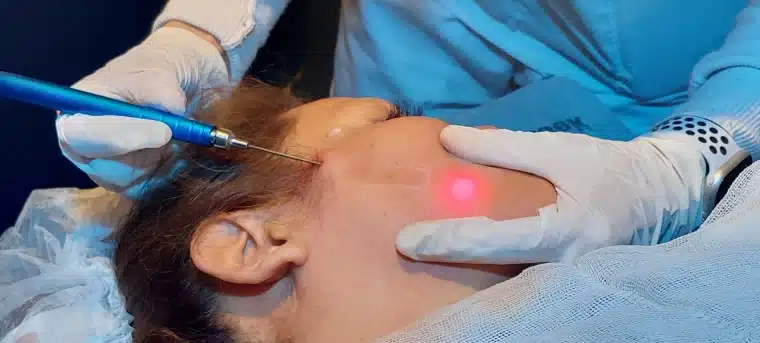
Because absorption is comparatively high, energy deposition tends to remain more localized around the emitting fiber. This can be useful when a protocol requires controlled heating, tissue coagulation, skin retraction, or collagen remodeling. In an endolifting procedure, a fine fiber can be guided along planned subdermal paths so that thermal treatment follows the anatomy selected by the clinician.
Localized heating can support lower-face, jawline, neck, submental, or selected body applications when clinically appropriate. The operator must control fiber movement, spacing, exposure, and total energy; results cannot be inferred from wavelength alone.
980nm: Broader Thermal Support Near Fat and Vessels
980nm has useful interaction with hemoglobin, together with moderate absorption by water and fat. Under comparable conditions, it can produce a broader thermal field and support coagulation of small vessels encountered along the treatment plane.
That profile is relevant to fiber laser lipolysis because adipose tissue is vascularized and surrounded by connective structures. Heat may assist localized fat disruption and subdermal contraction, while hemoglobin absorption may contribute to hemostatic control. These are capabilities, not guarantees.
Clinical literature has reported the use of 980nm diode lasers for laser-assisted lipolysis. Outcomes still depend on energy density, treated volume, fiber path, patient selection, aspiration decisions, and operator training. Product claims should therefore use conditional language and be supported by the exact protocol and indication.
Why a Dual-Wavelength Fiber Platform Adds Flexibility
The practical benefit of 980nm + 1470nm is complementary tissue absorption. A clinician can select the more localized water-mediated effect of 1470nm when precision and superficial tissue contraction are priorities, or use the broader thermal and hemoglobin-related profile of 980nm when vascularized tissue and coagulation are important.
The two wavelengths do not necessarily need to be delivered simultaneously. Depending on the device and protocol, they may be used independently, sequentially, or in a defined combination. This flexibility can be valuable for clinics that perform both facial endolaser and body lipolysis, or for distributors building a platform that serves aesthetic and minimally invasive surgical departments.
The key purchasing principle is simple: wavelength + fiber + parameters + technique. A dual-wavelength label has limited meaning unless buyers understand how energy exits the fiber, how output is controlled, and which accessories are validated.
Fiber Design Controls the Shape of the Treatment Zone
The optical fiber is the delivery tool that determines where laser energy leaves the system. Bare-tip, conical, side-emitting, and radial fibers distribute energy differently. Fiber diameter affects access and handling, while tip geometry influences whether the thermal field is mainly forward, lateral, or circumferential.
During a minimally invasive endolaser procedure, the clinician introduces the fiber into a selected subcutaneous plane and moves it through planned trajectories. A slow, even, fan-shaped movement can help distribute energy more consistently than holding the fiber stationary. The treatment endpoint should follow validated instructions and clinical monitoring rather than a generic power or time value copied from another machine.
For procurement teams, fiber compatibility should be checked alongside wavelength. Ask about available diameters, emission patterns, handpieces, cannulas, disposable components, sterilization or single-use requirements, output feedback, and operating modes. These details often determine whether a device is practical for real-world endolift lipolysis.
Introducing the Arfurla Application Platform
O 980nm + 1470nm diode laser application platform from Arfurla is positioned for facial endolaser, bodylift, skin tightening, and lipolysis. The 980nm + 1470nm diode laser category provides broader product context. Its description refers to a thin optical fiber inserted into the superficial layer, with controlled heat used to reduce localized fat and support tissue contraction.
For clinics, the relevant question is how the selected model, fiber set, and protocol fit the intended anatomy. For distributors, the evaluation should include product documentation, accessory supply, training, service response, consumables, and regulatory files for the destination market. The platform’s broader application range may be useful, but every additional indication still requires appropriate configuration and compliance review.
The manufacturer also states that it provides research, production, OEM/ODM, and after-sales support. Confirm warranty, spare parts, labeling, packaging, software, and technical documentation for the quoted model.
Laser Lipolysis and Liposuction Are Not Identical
Laser lipolysis uses fiber-delivered heat to affect localized adipose tissue. Treated fat may be left for physiologic clearance or removed through aspiration; adding suction creates laser-assisted liposuction and a more invasive workflow.
Terms such as endolift, endolifting, endolaser, laser lipo, lipolysis, and laser liposuction are used inconsistently. Before promotion or purchase, define anatomy, aspiration, anesthesia, operator qualifications, and legal scope in the target market.
Buyer Checklist for a 980nm + 1470nm Endolaser
Before requesting a quotation, verify:
- Independent control of 980nm and 1470nm output, including power and pulse or continuous modes.
- Compatible fiber diameters, tip designs, handpieces, cannulas, and recurring consumables.
- Output stability, calibration, cooling, emergency controls, and maintenance procedures.
- Model-specific protocols, contraindications, training, and adverse-event guidance.
- Regulatory documentation for each intended indication in the destination country.
- OEM/ODM options, labeling, packaging, warranty, technical files, and spare-parts support.
This checklist helps buyers compare complete treatment systems rather than comparing wavelength numbers in isolation.
Çözüm
980nm + 1470nm fiber laser technology combines two useful tissue-interaction profiles for endolift and laser lipolysis. 1470nm emphasizes localized, water-mediated heating near the fiber path, supporting controlled superficial tissue treatment and skin-tightening objectives. 980nm contributes hemoglobin interaction and broader thermal support near vascularized adipose and soft tissue. With suitable fiber design, parameter control, and trained technique, the combination can provide a flexible platform for facial endolaser, bodylift, and lipolysis applications.
For a configuration review, contact the Arfurla technical team with the intended anatomy, procedure, fiber preference, wavelength requirements, destination market, quantity, and OEM/ODM needs.
SSS
What is the main benefit of 980nm + 1470nm laser lipolysis?
The two wavelengths provide complementary absorption. 1470nm creates more localized water-mediated heating, while 980nm offers broader thermal interaction and useful hemoglobin absorption.
Does 1470nm target only fat?
No. Its principal relevant absorber is water, which is present in fat, connective tissue, vessels, and other structures. The response depends on fiber position and treatment parameters.
Why does fiber design matter in endolift treatment?
Fiber diameter and tip geometry determine access and the shape of energy distribution. They influence how evenly the operator can treat a planned subdermal path.
Is laser lipolysis the same as liposuction?
No. Laser lipolysis uses laser heat to affect adipose tissue. Liposuction removes fat by suction, and some laser-assisted protocols combine both approaches.
What should distributors request from a supplier?
Request the exact model specification, fiber and accessory list, operating modes, training materials, regulatory documents, service terms, consumables, and OEM/ODM options.